Why a China Kids Shoe Manufacturer Is the Smartest Choice for Your Footwear Brand
When brands and retailers start looking for a reliable China kids shoe manufacturer, they often discover that the options are far broader than they expected. China has spent decades building one of the most refined footwear supply chains on the planet, and what was once associated purely with volume production has matured into something altogether more sophisticated. Today, manufacturers based in China offer everything from early-stage design collaboration to finished private label products that arrive shelf-ready. For footwear businesses focused on children’s lines, women’s styles, or both, this kind of end-to-end capability matters enormously.
Bebenelle sits at an interesting intersection within this landscape. Operating as an English-language platform built to connect international buyers with Chinese manufacturing expertise, the company has positioned itself around accessibility and quality rather than simply lowest-cost volume. Whether a buyer needs OEM production, ODM development, or a full private label arrangement, the approach is structured to reduce friction at every step of the sourcing process.
The Kids Shoe Market Demands More Than Low Prices
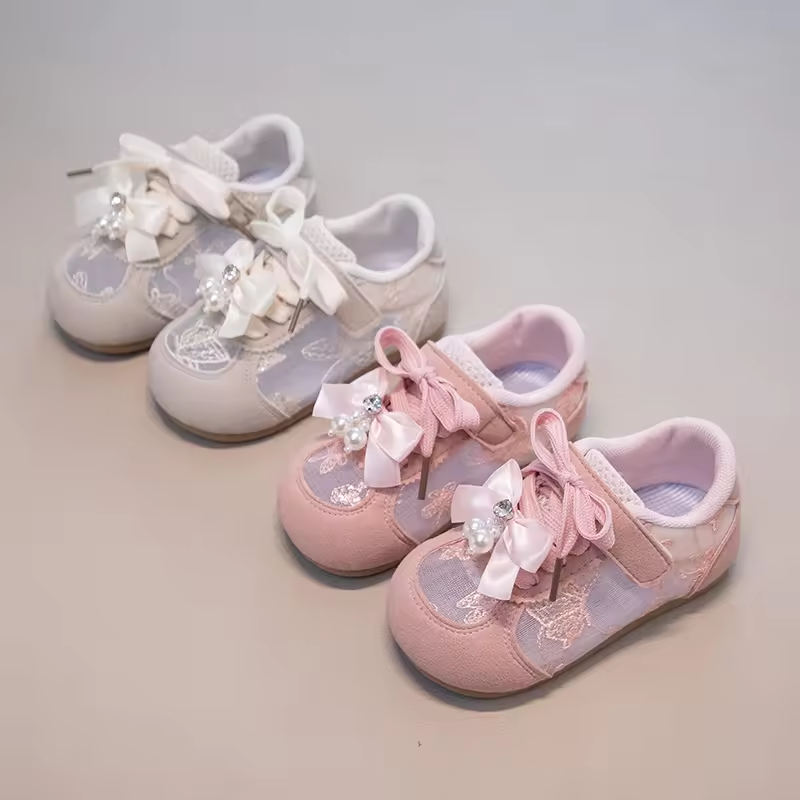
Children’s footwear is genuinely one of the more demanding product categories in the apparel and accessories space. Parents are not easily moved by price alone. They want shoes that hold their shape across weeks of active wear, fasten securely enough that a six-year-old can manage them independently, and use materials that sit comfortably against growing feet. Safety standards vary by market, but the expectation for durable construction is universal.
Working with a China kids shoe manufacturer that understands these requirements is not the same as working with one that simply manufactures to spec. There is a meaningful difference between a factory that treats a children’s sandal like a scaled-down adult product and one that has thought carefully about how toeing-off works for a three-year-old, or how a velcro closure panel needs to be reinforced to survive daily classroom use. Bebenelle’s focus on children’s lines reflects an awareness of these distinctions rather than just technical compliance with size charts.
OEM and ODM: Two Paths to Market
Buyers arrive with very different levels of readiness, and a capable manufacturer has to serve both ends of that spectrum. OEM (Original Equipment Manufacturing) arrangements suit brands that already have their designs locked in — technical drawings, material callouts, sizing grids — and simply need a production partner that can execute precisely and consistently. The brand owns the design; the manufacturer owns the production process.
ODM (Original Design Manufacturing) works differently. Here, the manufacturer contributes to or entirely leads the design process. A buyer might arrive with a concept or a category they want to enter — say, a line of lightweight toddler sneakers — without yet having a finished product specification. The ODM partner develops the design, sources materials, and produces samples for review. It compresses the timeline between idea and production considerably, which matters for brands trying to move fast or test new categories without heavy upfront investment in design resources.
Both models have genuine value depending on where a brand sits in its development. What matters is that the manufacturer can handle either cleanly, and that the handoff from concept to finished goods does not introduce problems that end up resolved through costly revisions later.
Women’s Footwear and the Case for Dual-Category Sourcing
Not every buyer coming to a China kids shoe manufacturer is exclusively focused on children’s products. Many footwear brands carry both kids and women’s lines, and there are real advantages to consolidating that production relationship with a single supplier. Shared logistics, consistent quality standards across categories, and a single point of contact for compliance and sampling all simplify what is otherwise a complicated operation.
Women’s footwear introduces its own set of design and production requirements — heel construction, last development, material drape in flats and mules — but the foundational sourcing considerations overlap substantially with children’s lines. A manufacturer that does both well has typically invested in breadth across materials, construction methods, and finishing capabilities that benefit any buyer working across multiple categories.
Private Label and What It Actually Means for Your Brand
Private label is a term that gets used loosely, but in footwear it generally means the buyer is building a line under their own brand name using the manufacturer’s existing tooling, designs, or both. It is a faster and usually more affordable entry point than full ODM development, because the foundation — lasts, outsoles, basic patterns — is already established.
The tradeoff is differentiation. Private label products may look similar to other offerings from the same factory unless the buyer puts thought into colorways, materials, branding elements, and packaging. The best private label arrangements are ones where the manufacturer is genuinely collaborative about customization within that framework, rather than offering a fixed catalog with minimal flexibility.
Bebenelle’s approach to private label is built around exactly this kind of collaboration — giving buyers a practical entry point while leaving room to build something that feels genuinely theirs rather than generic.
Language, Communication, and What Actually Goes Wrong in Sourcing
A significant portion of production problems in international footwear sourcing trace back not to manufacturing capability but to communication. Specifications get misread. Sample feedback does not land clearly. Timelines shift without notice because a buyer did not know which questions to ask upfront.
Operating as an English-language platform is not a cosmetic detail for Bebenelle — it reflects a structural choice to reduce these gaps. When buyers can communicate directly and clearly in English at every stage of the process, from initial inquiry through sampling and into full production, the error rate drops. What looks like a manufacturing problem often turns out to be a translation or interpretation problem that better communication would have caught earlier.
Practical Considerations Before You Source
For brands evaluating a China kids shoe manufacturer for the first time, there are a handful of questions worth settling before committing to production. Minimum order quantities matter — some factories work at scale and others can accommodate smaller runs that suit newer brands or seasonal testing. Sample lead times tell you a lot about how organized a factory actually is. And compliance documentation for target markets (CPSC in the US, EN 71 in Europe, for example) should be confirmed early rather than discovered as a problem after production is complete.
Bebenelle’s setup is designed to address these concerns upfront. The goal is not just to produce shoes but to help buyers understand what they are buying into before they have spent money on tooling and production runs.
Final Thoughts
The footwear industry has never been simple to navigate, and the kids shoe segment adds layers of expectation — around safety, durability, and design — that not every manufacturer meets consistently. Finding the right China kids shoe manufacturer means looking beyond price lists and factory scale to ask how well a partner actually understands the product and the buyer’s business. Bebenelle was built with that question in mind. For brands ready to explore what working with a capable, English-speaking Chinese footwear manufacturer actually looks like, it is a practical and worthwhile starting point.