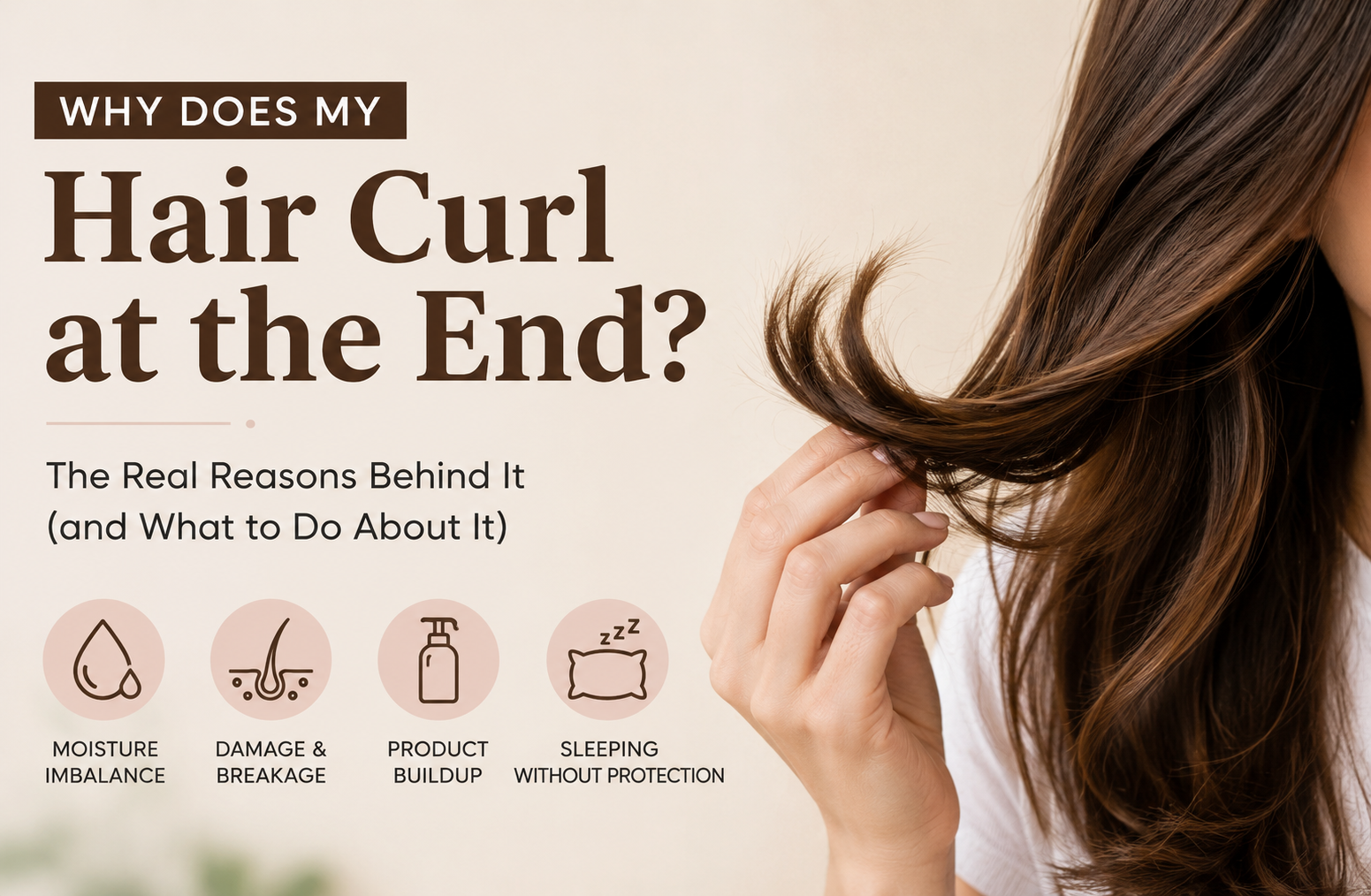
Why Does My Hair Curl at the End? The Real Reasons Behind It (and What to Do About It)
You wash your hair. You style it. And then — somewhere between drying and the end of your morning routine — you notice it: the tips of your hair are curling, even though the rest of your strands seem perfectly straight or loosely waved. If this sounds familiar, you are far from alone.
Hair that curls specifically at the ends is one of the most common — and most misunderstood — hair phenomena out there. Sometimes it is a health signal. Sometimes it is simply the way your hair naturally grows. And sometimes it is the result of something you are doing (or not doing) in your routine.
Understanding why does my hair curl at the end is actually one of the most useful things you can do for your overall hair health — because the answer tells you a great deal about your hair’s porosity, protein levels, hydration, and even the tools you use every day. Let’s break it all down.
First, What Makes Hair Curl in the First Place?
To understand why your ends curl, you need a basic understanding of hair biology. Every strand of hair grows out of a follicle embedded in your scalp. The shape of that follicle — round, oval, or asymmetrical — determines your natural curl pattern. Round follicles produce straight hair; oval and asymmetrical follicles produce wavy, curly, or coily hair.
But the follicle is not the only variable. The cortex of the hair shaft is made up of two types of cells — orthocortex and paracortex — and their arrangement influences how much a strand curves. In curly hair, these cell types are distributed unevenly, creating an internal tension that causes the strand to bend, spiral, or coil.
Your ends, however, are the oldest part of your hair. They have been exposed to more — more friction, more heat, more environmental damage, more product — than any other part of the strand. So even if your roots and mid-lengths behave one way, your ends can behave quite differently. And that difference often manifests as a curl.
7 Reasons Your Hair Curls at the Ends
1. Your Natural Curl Pattern Is Expressing Itself
Many people have what is called a “wavy-straight” pattern: hair that appears straight or only slightly wavy at the root but becomes progressively curlier toward the ends. This is especially common in people with fine to medium hair. The weight of the hair near the root keeps it straight, but the lighter, more delicate ends are free to curl.
If this is your situation, no amount of styling or product will permanently straighten your ends — and honestly, you might not want to. This natural bend is part of your texture, and working with it rather than against it usually produces better results.
2. Moisture Imbalance — The Most Common Culprit
When the outer layer of the hair shaft (the cuticle) is lifted or damaged, it becomes highly sensitive to changes in humidity. The ends absorb moisture from the air unevenly, causing them to swell and curl while the better-protected mid-lengths stay relatively straight. This is why your hair might look great indoors but immediately frizz and curl at the ends the moment you step outside.
The solution is not to block out moisture — it is to ensure your hair is uniformly moisturized before it encounters environmental humidity. A well-moisturized strand has a smoother cuticle that responds to humidity less dramatically.
3. Protein Deficiency
Keratin is the structural protein that gives hair its strength and shape. When hair lacks adequate protein — due to chemical processing, excessive heat, or a diet low in protein-rich foods — the shaft weakens and loses its ability to hold its shape. The ends, being the most fragile part of the strand, are usually the first to curl, buckle, or develop what is sometimes called “knots” or “fairy knots.”
A protein treatment every four to six weeks can help rebuild structure and reduce this type of curling. Look for treatments containing hydrolyzed keratin, silk amino acids, or wheat protein.
4. Heat Damage — in Reverse
This one surprises people. Most people assume heat damage makes hair straight. And in extreme cases, it does — it breaks down the bonds that create natural curl, leaving hair limp and unable to curl at all. But in mild to moderate heat damage, the cuticle is roughened and lifted rather than fully destroyed. The result? Hair that curls and bends unpredictably, often at the ends, because the damaged cuticle catches and folds on itself rather than lying flat.
If you have been using flat irons or curling wands regularly on high heat and your ends have become strangely curly (not in the way they used to be), this could be the cause.
5. Product Buildup
Silicones, heavy oils, and waxy ingredients can coat the hair shaft and create uneven weight distribution. When too much product accumulates at the ends — which happens easily because the ends have the most surface area and tend to get extra product during application — they can clump together and curl inward. A monthly clarifying wash removes this buildup and resets your hair to its natural state.
6. Your Cut
The way your hair is cut has a significant influence on how the ends behave. Blunt cuts distribute weight evenly and can cause curly or wavy hair to curl under at the ends (the classic “bob curl” you see at the bottom of a blunt cut). Layered cuts remove weight and allow curls to spring up rather than curl inward. If your hair curls at the ends in a way that feels heavy or mushroom-shaped rather than naturally textured, a layered cut with a stylist who specializes in curly hair may be the fix.
7. Sleeping Without Protection
Friction from cotton pillowcases causes the cuticle to roughen overnight, and the repeated folding of hair under the weight of your head as you move in sleep creates mechanical curls at the ends — the kind that have nothing to do with your natural pattern. A satin or silk pillowcase, or wrapping your hair in a satin bonnet before bed, eliminates this entirely.
How to Tell Which Type of End-Curling You Have
A simple test: wash your hair with no products and let it air dry completely. If your ends curl naturally, it is likely your natural pattern. If they are straight but rough-feeling or frizzy, it is likely damage or dryness. If they curl more than usual after a humid day, moisture imbalance is the issue.
This distinction matters because the treatments for each cause are completely different. Treating natural curl as damage leads to over-processing. Treating damage as a natural pattern means ignoring a problem that will only get worse.
What to Do About Straight Ends on Curly Hair
The Dusting Technique
If your ends are dry, splitting, or curl-resistant while the rest of your hair is thriving, the simplest solution is often a trim. “Dusting” refers to removing just the very tips of the hair — 1/8 to 1/4 inch — to get rid of split and frayed ends without sacrificing significant length. Done every eight to ten weeks, dusting keeps ends healthy and reduces the contrast between your defined mid-lengths and your struggling ends.
End-Targeted Deep Conditioning
Many people apply deep conditioner to their scalp and mid-lengths and then forget about their ends — or worse, apply product to dry ends that cannot absorb it properly. Try this instead: saturate your ends with water first, then apply deep conditioner specifically to the last two to three inches of your hair. Twist those ends up and leave the treatment on for at least 20 to 30 minutes. You will notice a difference within one wash day.
Seal with Oil
After conditioning and before styling, apply a small amount of a sealing oil — argan, jojoba, or avocado oil work especially well for this — specifically to your ends. This creates a protective barrier that slows moisture loss throughout the day and prevents the ends from absorbing and releasing humidity at the dramatic rate that causes the frizz-curl cycle.
Managing straight ends on curly hair is one of the trickier aspects of curly haircare because it requires addressing the ends differently from the rest of your strands — which often means adjusting how you apply products, how you dry your hair, and how frequently you trim. The full breakdown of causes and fixes, including product recommendations by hair type, can be an invaluable starting point if you’re struggling with this.
Building a Routine That Protects Your Ends
Ends need special attention in every step of your routine, not just treatments. Here is a framework that works for most curl types:
- Detangle gently from ends to roots — never root to ends. This prevents yanking curls through tangles and reduces the mechanical damage that causes split ends.
- Apply products while soaking wet — particularly at the ends. Dry or damp application means the product cannot penetrate, so it simply sits on top and either builds up or flakes off.
- Avoid touching your hair while it dries — every time you disrupt drying curls, you create friction that roughens the cuticle and causes frizz — especially at the ends.
- Use a microfiber towel or cotton T-shirt — for blotting. Regular terry cloth is too rough on the cuticle layer.
- Protect at night — either with a satin bonnet, satin pillowcase, or pineapple method. This is non-negotiable if you want to preserve your curl pattern — and your ends — overnight.
When to See a Professional
If your ends are curling in a way that is new, sudden, or accompanied by excessive breakage, brittleness, or a change in texture you did not choose, it may be time to visit a curly hair specialist. Changes in curl pattern can sometimes indicate hormonal shifts (pregnancy, thyroid changes, menopause), significant nutritional deficiencies, or scalp health issues that are worth addressing at the root — literally.
A licensed stylist who specializes in curly and textured hair can assess the physical condition of your strands under magnification, recommend targeted treatments, and give you a cut that works with your pattern rather than against it.
The Bottom Line
Hair that curls at the ends is not a problem to be fixed — it is information. It tells you something about your hair’s natural pattern, its hydration levels, its protein balance, the tools and products you are using, and the environment it lives in. When you learn to read those signals, you are no longer fighting your hair. You are working with it.
Start by identifying your type of end-curling, address the most likely cause (moisture balance and protective habits are the right place for most people to begin), and give your routine two to four weeks to show results. Hair responds to consistency — and the payoff is worth it.