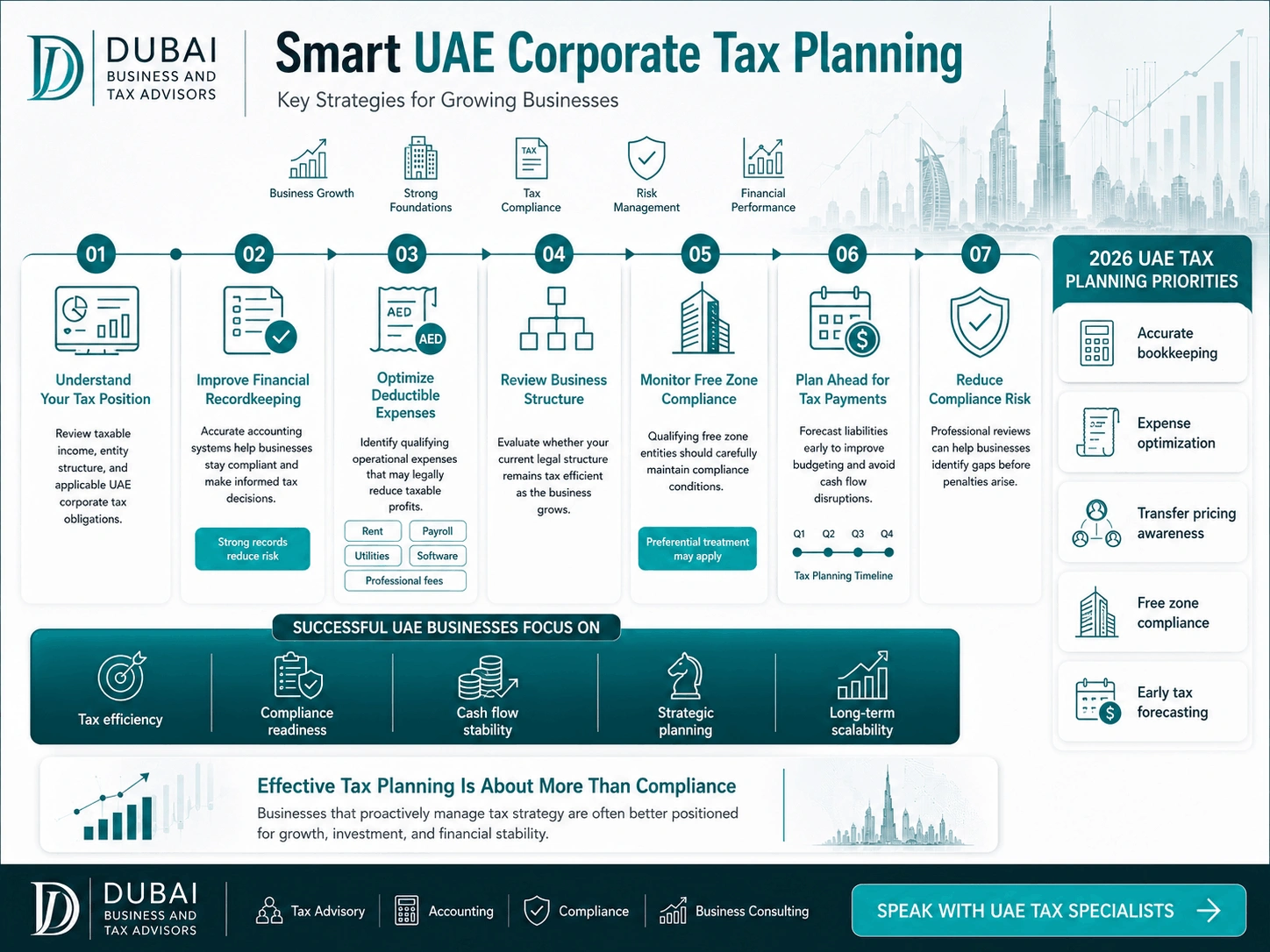
UAE Corporate Tax Planning Strategies Every Business Owner Should Know
Many profitable businesses across the Emirates are quietly paying more tax than the law actually requires. Perhaps you assume that your current accounting practices are sufficient, or that corporate tax is a burden only for multinational giants. In reality, the most effective tax strategies are built long before the fiscal year ends, not during the frantic final week of filing. When you integrate sound tax and business advisory into your day-to-day operations, you stop viewing tax as an unavoidable cost and start seeing it as a variable you can manage with precision. This guide walks you through the fundamentals of UAE corporate tax, how to navigate your obligations, and the practical steps that turn compliance into a competitive advantage.
Understanding UAE Corporate Tax Before You Start Planning
Corporate tax in the UAE is a federal direct tax levied on the net income of businesses. It was introduced to align the country with international tax standards, diversify government revenue, and reinforce the UAE’s reputation as a transparent global business hub.
The Mechanism
The system is surprisingly straightforward once you strip away the jargon. For most businesses, the first AED 375,000 of taxable income is taxed at 0%. Any taxable profit exceeding that threshold is taxed at a flat rate of 9%. It is critical to distinguish this from revenue; corporate tax applies to your net profit after allowable deductions, not your total turnover.
Who Is Subject to Corporate Tax?
Most entities operating in the UAE fall under these regulations, including Mainland companies, Free Zone entities, SMEs, startups, and even freelancers or consultants who exceed specific revenue thresholds. Do not assume your business is exempt just because it is small or based in a Free Zone. Even if your profit sits within the 0% bracket, registration remains a compulsory federal requirement.
Common Misunderstandings
Business owners often trip up on three common myths:
- Tax applies to my revenue.It does not; it applies to your net profit.
- Being in a Free Zone means zero tax.This is only true if you meet strict “Qualifying Free Zone Person” criteria.
- No profit means no compliance.Registration and filing requirements usually persist regardless of your profitability.
Why Tax Planning Matters More Than Tax Filing?
Filing a return is a legal obligation; tax planning is a strategic choice. Reactive tax management where you only look at your numbers when a deadline looms almost always leads to missed deductions, unnecessary cash flow pressure, and an increased risk of audits. Proactive planning allows you to forecast your liability, align your operational decisions with tax efficiencies, and ensure your cash reserves are ready when the payment date arrives.
10 UAE Corporate Tax Planning Strategies
Understand Your Taxable Income Position Early
Waiting until the end of the year to check your numbers is a dangerous game. Review your financial performance quarterly to see if you are trending toward the 9% threshold.
Maximize Legitimate Business Expense Deductions
You can only deduct expenses that are “wholly and exclusively” incurred for business purposes. Keep rigorous records for every dirham spent; undocumented expenses are automatically disallowed during an FTA review.
Use Small Business Relief Where Eligible
If your revenue is AED 3 million or less, you may elect for Small Business Relief. This can treat your taxable income as zero for that period, significantly reducing your compliance burden.
Consider Whether Tax Grouping Makes Sense
If you own multiple companies (with 95% common ownership), you can often form a tax group. This allows you to file a single return and offset losses from one entity against the profits of another.
Review Related-Party Transactions Carefully
Transactions between your own companies or related parties must be conducted at “arm’s length.” If you charge an internal company a different price than you would a third party, you invite significant audit risk.
Protect Tax Loss Relief Opportunities
If your business takes a loss in a lean year, you can often carry that loss forward to offset future taxable income. Strategic planning ensures you do not waste these valuable tax assets.
Optimize Free Zone Tax Benefits
To maintain your 0% rate, you must perform “qualifying activities.” Ensure your income streams are correctly classified, or you risk accidental disqualification.
Separate Personal and Business Finances
Mixing your personal coffee receipts with your business utility bills is a red flag for any auditor. Maintain a clean, dedicated business bank account to keep your records audit-ready.
Build Tax Planning Into Business Decisions
Before you hire new staff, open a new branch, or invest in heavy machinery, ask yourself how that decision impacts your tax position for the coming year.
Conduct Regular Tax Health Checks
An internal review every six months can spot inconsistencies in your bookkeeping before they turn into a major problem.
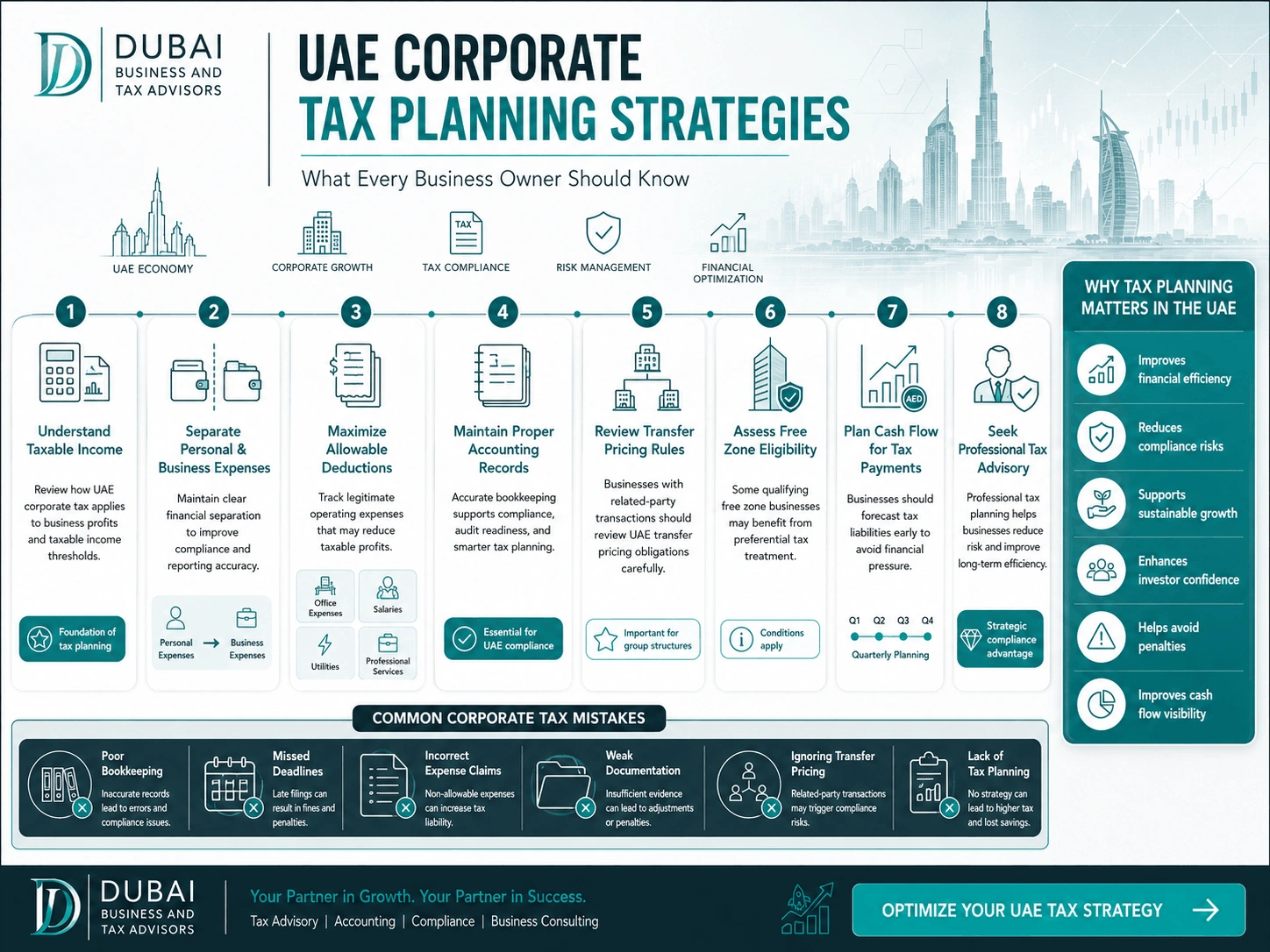
How Much Corporate Tax Could Your Business Actually Pay?
Consider a small consultancy firm billing AED 1,000,000 annually with AED 400,000 in legitimate business expenses. Your net profit is AED 600,000. Under current rules, the first AED 375,000 is taxed at 0%, while the remaining AED 225,000 is taxed at 9%, resulting in a liability of AED 20,250. Through proactive expense management and planning, a similar firm might be able to reduce their profit margin slightly to lower that bracket, or they might utilize loss carry-forwards from a previous year to minimize the impact.
Why Some Free Zone Companies Lose Their 0% Benefits?
Qualifying Free Zone status is not a permanent state; it is a condition you must maintain. If your income includes revenue from prohibited activities, or if you fail to maintain adequate substance within the zone, the FTA may reclassify your income. Many companies lose their status because they provide services to the “Mainland” that do not qualify as exempt or because they fail to prepare audited financial statements.
Corporate Tax and Cash Flow(The Overlooked Risk)
Tax is a cash flow event. A business can be profitable but still fail because it didn’t set aside the cash to pay its tax bill in time. Treat your estimated tax liability as a monthly operating expense. By building a tax reserve account throughout the year, you avoid the panic of a large, unexpected payment when the filing deadline hits.
When Does Professional Tax Support Become Valuable?
Basic bookkeeping handles the day-to-day, but strategic planning requires a deeper understanding of the law. You should seek external support when your business model involves multiple entities, complex related-party transactions, or an expansion into new Free Zones.
This is where expert tax and business advisory becomes essential. An advisor does not just fill out your forms; they evaluate your business structure, identify risks you haven’t seen, and help you navigate the grey areas of regulatory updates.
The Difference Between Accounting Support and Strategic Tax Planning
While accounting focuses on the historical record of what happened in the past, strategic planning focuses on the future. Accounting ensures your books balance; planning ensures your business structure is as efficient as possible.
Frequently Asked Questions
What is UAE Corporate Tax and who does it apply to?
UAE Corporate Tax was introduced in June 2023 at a standard rate of 9% on taxable income exceeding AED 375,000, with a 0% rate on income below that threshold. It applies to mainland businesses, Free Zone entities that do not meet Qualifying Free Zone Person conditions, and foreign companies with a permanent establishment in the UAE. Understanding whether and how Corporate Tax applies to your business is the essential first step in building an effective tax planning strategy.
What is the difference between tax avoidance and legitimate tax planning in the UAE?
Legitimate tax planning means structuring your business to take full advantage of exemptions, reliefs, and incentives the law specifically allows such as Free Zone benefits or small business relief. Tax avoidance, by contrast, involves artificially arranging transactions purely to reduce tax in a way that contradicts the intent of the law. The FTA has strong anti-avoidance provisions in place, and any arrangement lacking genuine commercial substance can be challenged and penalised. Always ensure your planning strategies are legally sound and commercially justifiable.
How can Free Zone businesses benefit from Corporate Tax planning?
Free Zone businesses can potentially access a 0% Corporate Tax rate on qualifying income but only if they meet strict FTA conditions. To qualify, your business must maintain adequate substance in the Free Zone, earn income within the approved categories, and comply with transfer pricing rules. Many Free Zone businesses unknowingly disqualify themselves by conducting activities outside the qualifying criteria, instantly exposing them to the standard 9% rate. Strategic planning around these conditions is not optional, it is essential.
What is small business relief and how can UAE businesses use it?
Small business relief allows eligible businesses with revenue of AED 3 million or less to elect for zero Corporate Tax liability for a given tax period. This relief is available for periods ending on or before 31 December 2026 and must be actively elected each year. It is a significant opportunity for small and growing businesses, but the eligibility conditions must be carefully reviewed annually. Electing for this relief also restricts access to certain other tax benefits in the same period, so professional guidance is strongly recommended before making the decision.
How do transfer pricing rules affect Corporate Tax planning?
Transfer pricing rules require that transactions between related parties such as between a parent company and its subsidiary are conducted at arm’s length, reflecting the same pricing that would apply between independent parties. For business owners with multiple entities or cross-border arrangements, this is a critical planning area. Non-compliance allows the FTA to adjust your taxable income upward, increasing your tax liability and triggering penalties. Maintaining proper transfer pricing documentation is a legal requirement, not a formality.
Conclusion
The most successful business owners in the UAE do not obsess over paying the least amount of tax possible, they obsess over making informed business decisions. Corporate Tax compliance is no longer a one-off annual event. It is a continuous cycle of documentation, strategy, and adjustment that demands the right expertise behind it.
By integrating professional tax guidance into your financial management, you stop treating compliance as a burden and start using it as a framework for smarter, more confident growth. In a tax landscape that is still evolving, that mindset is what separates businesses that struggle from businesses that scale.
Dubai Business & Tax Advisors helps UAE business owners do exactly that. From Corporate Tax structuring and Free Zone compliance to transfer pricing and accurate tax filings, their specialists handle the complexity year-round ensuring your tax position stays optimised, compliant, and aligned with your business goals.