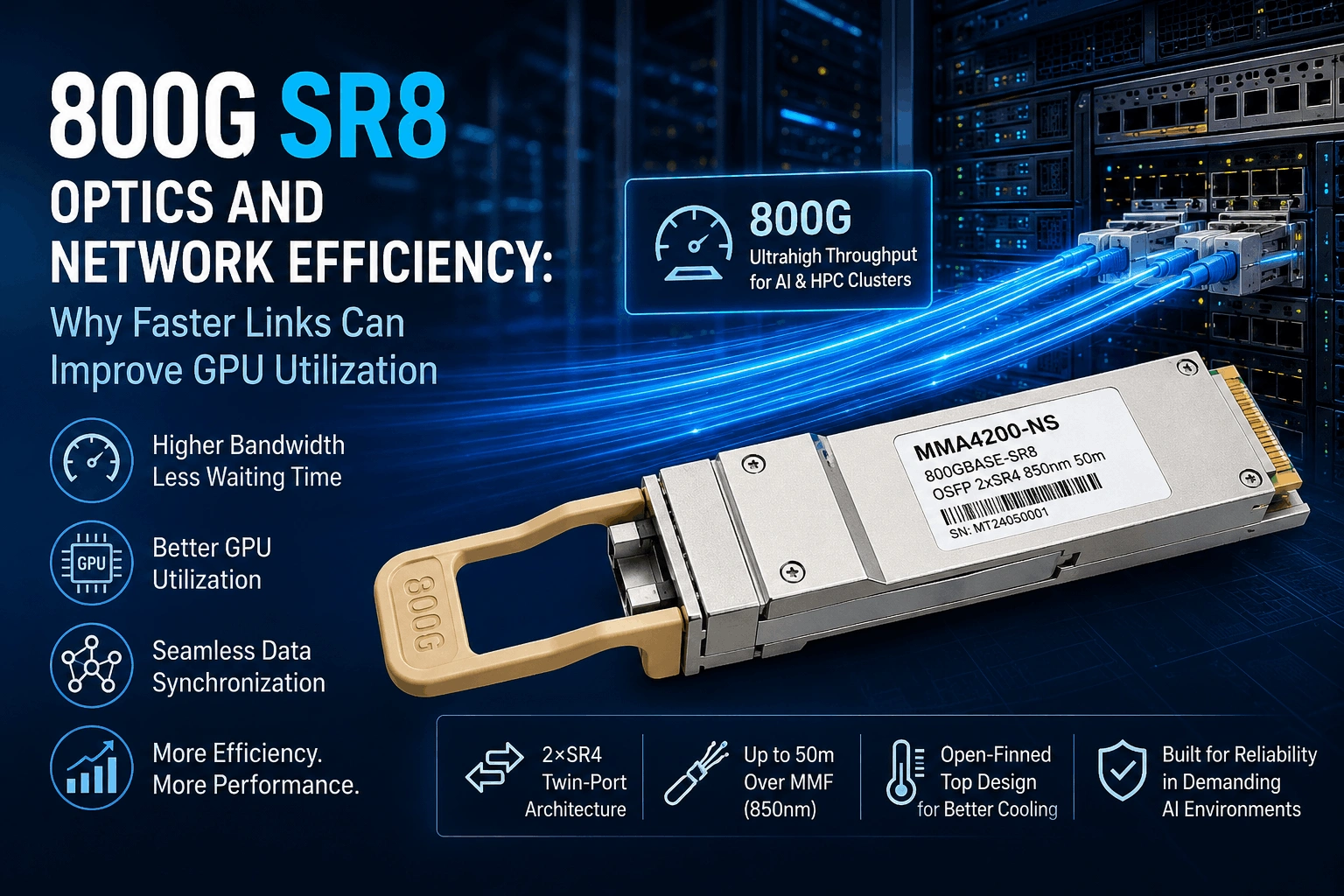
800G SR8 Optics and Network Efficiency: Why Faster Links Can Improve GPU Utilization
The Most Expensive Part of an AI Cluster Isn’t the Network
When organizations invest in AI infrastructure, most of the budget usually goes toward GPUs.
A modern training cluster can represent millions of dollars in compute resources. Naturally, most discussions focus on accelerator performance, memory capacity, and model scaling. Networking is often viewed as supporting infrastructure—a necessary component, but not the primary investment.
However, once large-scale training begins, a different reality emerges.
The value of a GPU is directly tied to how much useful work it can perform. If accelerators spend time waiting for data, synchronizing parameters, or exchanging information across the cluster, a portion of that investment is effectively sitting idle.
This is why network efficiency has become such an important topic in AI infrastructure.
Products like the NVIDIA/Mellanox MMA4Z00-NS compatible 800GBASE-SR8 (2×SR4) twin-port OSFP transceiver are not simply about delivering more bandwidth. Their real purpose is helping expensive compute resources spend less time waiting and more time processing.
AI Workloads Depend on Constant Communication
Traditional enterprise applications often generate bursty traffic patterns.
A database responds to requests. A web server delivers content. Users access resources intermittently throughout the day. While bandwidth is important, traffic is rarely synchronized across thousands of systems simultaneously.
AI training behaves very differently.
Large GPU clusters constantly exchange information. Training data moves across nodes, gradients are synchronized between accelerators, and model parameters are updated continuously throughout the training process.
This communication happens repeatedly and at enormous scale.
As models grow larger and training clusters become denser, the network starts carrying a larger share of the workload. The speed of the GPUs becomes less relevant if the fabric connecting them cannot keep pace.
In this environment, bandwidth directly influences compute efficiency.
Why 800G Is About Reducing Waiting Time
One way to think about high-speed networking is to view it as a tool for reducing idle time.
Every time a GPU waits for information from another node, productivity drops. Individually, those delays may seem insignificant. Across thousands of accelerators running for weeks, however, they become substantial.
Higher-bandwidth interconnects help reduce these delays.
The 800GBASE-SR8 architecture provides enough throughput to move large volumes of traffic across the fabric quickly, allowing synchronization tasks to complete faster and enabling GPUs to return to computation sooner.
The result isn’t merely a faster network.
It’s a more efficient cluster.
And when GPU resources are among the most expensive assets in the data center, improving efficiency often delivers more value than simply adding additional hardware.
Why Short-Reach Optics Dominate AI Fabrics
Interestingly, many of the most important connections inside AI environments are relatively short.
Servers are typically located in the same row, neighboring racks, or nearby network pods. Most traffic remains inside the data center rather than crossing cities or regions.
Because of this, long-distance optical technologies aren’t necessarily the best fit.
The NVIDIA/Mellanox MMA4Z00-NS compatible module uses an 850nm multimode optical design and supports transmission distances up to 50 meters over multimode fiber. This makes it ideal for the kinds of dense deployments commonly found in AI clusters.
Rather than optimizing for distance, it optimizes for high-bandwidth communication where the workload actually exists.
That distinction is important.
The goal is not reaching farther. The goal is moving more data between nearby systems as efficiently as possible.
The Advantage of the 2×SR4 Twin-Port Architecture
Another interesting aspect of this module is its twin-port 2×SR4 design.
While many people focus on the headline 800G speed, the architectural flexibility is equally valuable.
The module effectively supports two independent 400G optical channels within a single OSFP form factor. This allows infrastructure teams to design networks around different deployment strategies without changing optical hardware.
Some environments use the full 800G capability to maximize switch bandwidth. Others use breakout configurations to connect multiple devices while maintaining efficient port utilization.
This flexibility becomes particularly useful in growing AI environments where infrastructure requirements may evolve rapidly over time.
Instead of locking the network into a single topology, the optical layer can adapt alongside the cluster.
Why Thermal Performance Influences Reliability
Network efficiency isn’t solely determined by bandwidth.
Reliability plays a major role as well.
High-performance AI environments place significant thermal stress on networking equipment. Dense GPU racks, high-power switches, and continuous workloads create challenging operating conditions throughout the data center.
The open-finned top design used in air-cooled OSFP modules addresses this challenge directly.
By improving airflow and heat dissipation, the module helps maintain stable operating temperatures inside NVIDIA Quantum-2 InfiniBand and Spectrum-4 Ethernet switching environments.
Stable temperatures contribute to stable performance.
And stable performance is critical when thousands of GPUs depend on uninterrupted connectivity.
Supporting the Shift Toward Larger Clusters
The scale of AI infrastructure continues increasing.
Organizations that once deployed hundreds of GPUs are now deploying thousands. Some of the largest clusters contain tens of thousands of accelerators connected through complex networking fabrics.
As this growth continues, the importance of interconnect technology grows alongside it.
Bandwidth, density, thermal efficiency, and deployment flexibility all become increasingly important. High-speed optics are no longer niche components reserved for specialized environments—they are becoming foundational infrastructure for modern AI computing.
Modules such as the MMA4Z00-NS compatible 800GBASE-SR8 reflect this shift.
They are designed not simply to connect devices, but to support the operational demands of large-scale distributed computing.
Conclusion
The NVIDIA/Mellanox MMA4Z00-NS compatible 800GBASE-SR8 twin-port OSFP optical module plays a crucial role in improving the overall efficiency of AI and HPC clusters. By providing ultra-high-bandwidth short-range connectivity, it helps reduce communication bottlenecks that can limit GPU utilization during distributed workloads. Its 2×SR4 architecture, compatibility with Quantum-2 InfiniBand and Spectrum-4 Ethernet platforms, and air-cooled thermal design make it well suited for the dense, performance-driven environments that define modern AI infrastructure. As clusters continue growing in size and complexity, efficient networking becomes increasingly important—not just for moving data faster, but for ensuring valuable compute resources spend more time working and less time waiting.