Measuring Success at AI Summits: Booth Performance, Leads, and Engagement Metrics
You Showed Up. But Did You Win?
There’s a particular kind of post-summit silence every exhibitor knows. The crowd has thinned, the badge lanyards have been stuffed into laptop bags, and your team is gathered around a table asking the same question that haunts every booth manager: Was it worth it?
At AI summits, specifically where every attendee is either building, buying, or evaluating intelligence-driven technology, the stakes are uniquely high. These are not casual trade show crowds.
According to the Center for Exhibition Industry Research, 81% of trade show attendees have buying authority. The person who paused at your booth for four minutes may be a VP of Engineering with a six-figure procurement decision sitting on their desk. Measuring your success correctly isn’t just good practice. It’s the only way to know if you’re talking to the right people.
First: Stop Counting Badge Scans as Success
The most common mistake exhibitors make is treating badge scans as the primary metric of booth performance. It’s the equivalent of measuring a job interview by how long the handshake lasted.
Trade show ROI is measurable in terms of leads generated, direct sales, and brand awareness, but most planners agree that measuring success depends on several factors, including total cost, attendance, attendee engagement, ROI, and positive feedback. Notice that “number of badges scanned” doesn’t appear on that list.
What you actually want to track is intent. A B2B exhibition that applied intent scoring to booth interactions allowed sponsors to prioritize follow-up based on behavior rather than badge scans alone, and conversion rates improved significantly as a result.
This is the difference between a list of names and a pipeline.
The Four Metrics Of AI Summits
1. Qualified Lead Rate, Not Raw Lead Volume
Qualified leads measure how many leads fit your ideal customer profile and are actually worth pursuing, and this is far more important than raw lead quantity. At an AI summit, a qualified lead might be a CTO actively evaluating vendors, not a developer who stopped by for the branded canopy and branded pen.
A practical benchmark: aim for at least 30 – 40% of your captured contacts to meet your ICP criteria. If that number is lower, the problem likely isn’t foot traffic. Instead, it’s your booth’s messaging or positioning.
2. Dwell Time and Demo Engagement
How long did people stay? Interactive elements like survey kiosks and instant prize wheels increase dwell time by 28% compared to static displays, while live product demonstrations create memorable experiences that drive social sharing and word-of-mouth referrals.
At AI-focused events, live demos are your single most powerful conversion tool. A prospect who watches a 3-minute live walkthrough of your platform retains far more than one who grabbed a brochure.
Track how long visitors stayed at your booth, how many people attended your product demos, and how many meaningful conversations your team had. These interactions provide a clearer picture of how well your booth engaged your target audience.
3. Cost Per Lead and What You’re Comparing It To
The average cost per lead at trade shows is around $112, while a face-to-face meeting costs $142 per meeting at trade shows versus $250 at a prospect’s office, and it’s 38% less expensive to convert a trade show lead than relying on sales calls alone.
It’s essential while building the business case for your event budget. A well-executed booth at an AI summit is a compressed sales infrastructure instead of a simple marketing spend.
4. Post-Event Pipeline Velocity
The metric most teams skip is pipeline velocity: how quickly do summit leads move through your sales funnel compared to leads from other channels? Mid-market exhibitors typically see $3 -5 pipeline value for every $1 invested in booth strategy, with 25 – 40% of leads converting within 90 days post-show.
Your Booth Is a Physical Signal – Treat It Like One
Before you can measure engagement, you need people to stop. At dense AI summits where every vendor is promising the future, your physical presence is your first filter.
A well-designed outdoor or overflow setup like a heavy duty canopy tents creates an ownable visual zone that anchors your brand in attendee memory before a single conversation begins.
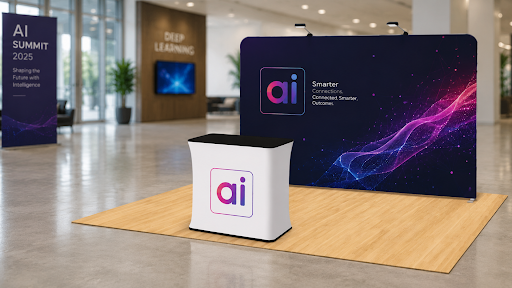
For indoor footprints, trade show display booths with fabric pop-up structures give you flexibility, fast setup, and a polished presence without the overhead of custom-built structures.
According to exhibitor research, 48% of exhibitors say eye-catching displays attract the most attendees and at an AI summit where differentiation is intellectual rather than visual, your physical environment is often the only obvious differentiator before the pitch begins.
The Follow-Up Window Is Shorter Than You Think
Here’s the uncomfortable truth most summit teams discover too late: 51% of attendees request a follow-up visit from a sales representative post-event, but attention decays fast. The 72-hour window after a summit is the highest-intent period you’ll have with any lead you captured.
Set a post-mortem meeting within one week after the event to gather feedback from staff, review analytics, and document lessons learned. There is no chance of improving next time, but closing this time.
The Scoreboard You Should Follow
Success at an AI summit booth isn’t a feeling. It’s a number. Build your post-event scorecard around these five pillars: qualified lead rate, average dwell time per visitor, cost per qualified lead, pipeline created within 30 days, and deals influenced within 90 days.
AI-enabled systems can now automatically trigger workflows, campaigns, or sales alerts based on real-time lead score thresholds, which means the data you capture at your booth today can feed intelligent follow-up systems that do the heavy lifting after you’ve packed up.
The exhibitors who win at AI summits aren’t necessarily the ones with the biggest booth or the loudest pitch. They’re the ones who treat every interaction as data and know exactly what to do with it.