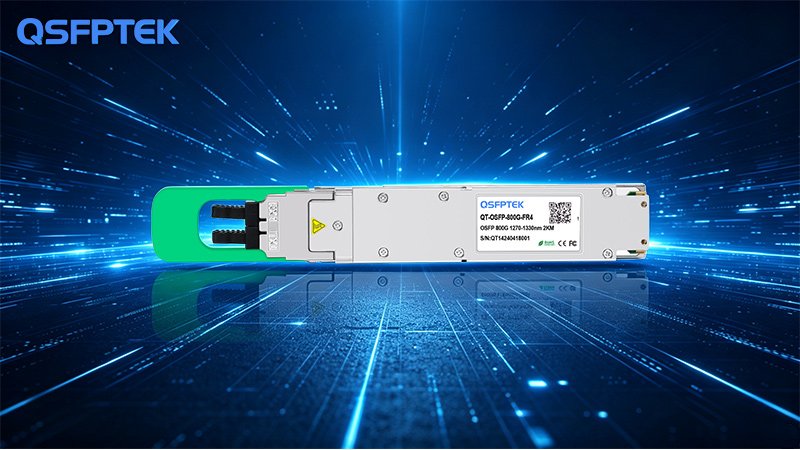
Connecting AI Storage Fabrics with 800G FR4
When discussing AI infrastructure, most attention is given to GPUs, high-performance switches, and large-scale training clusters. However, storage networks play an equally important role in overall AI performance. Even the most powerful GPUs cannot operate efficiently if they spend time waiting for training data to arrive.
As AI models grow larger and datasets expand into the petabyte range, the connection between compute resources and storage systems becomes increasingly critical. This is where 800G OSFP FR4 optical modules are beginning to play an important role, providing the bandwidth and reach needed to support modern AI storage fabrics.
The Storage Challenge in AI Environments
Unlike traditional enterprise applications, AI workloads generate enormous amounts of data movement. During training, GPU clusters continuously read datasets, write checkpoints, and exchange model information with distributed storage platforms.
Large language models, recommendation systems, and multimodal AI applications often rely on high-performance storage architectures built on technologies such as parallel file systems, distributed NAS, or object storage platforms.
As GPU performance increases, storage networks must keep pace. Otherwise, data delivery becomes a bottleneck that limits overall cluster efficiency.
For many organizations, the challenge is no longer computing power but ensuring that data can reach GPUs quickly enough.
Why Storage Fabrics Need Higher Bandwidth
Modern AI clusters frequently contain hundreds or thousands of GPUs operating simultaneously. These systems may access the same datasets, training files, and checkpoints at the same time.
As network traffic grows, traditional 100G and 200G connections can become congested, especially during large-scale training jobs or data synchronization processes.
Deploying 800G links significantly increases available bandwidth between storage systems and AI compute resources. Higher throughput allows more data to move across the network with fewer bottlenecks, helping maintain consistent GPU utilization.
For storage administrators, this means improved performance without requiring a dramatic increase in network complexity.
The Advantages of 800G FR4 in AI Storage Networks
Among various 800G optical technologies, FR4 offers several advantages for storage fabric deployments.
First, 800G FR4 supports transmission distances of up to 2 kilometers over duplex single-mode fiber. This allows storage arrays, GPU clusters, and network switches to be deployed in different rows, halls, or even separate facilities while maintaining high-speed connectivity.
Second, FR4 uses duplex LC connectivity rather than the multi-fiber MPO interfaces commonly found in parallel-optics solutions. This simplifies cabling management and reduces the operational complexity associated with large-scale deployments.
Third, single-mode fiber infrastructure provides greater flexibility for future expansion. As AI environments continue to grow, organizations can extend network reach without being constrained by multimode distance limitations.
Supporting Distributed File Systems
Distributed file systems have become a foundational component of modern AI infrastructure. Platforms such as parallel storage systems distribute data across multiple storage nodes to improve scalability and performance.
These architectures require substantial east-west traffic between storage servers, metadata services, and compute clusters.
800G FR4 modules help support this communication by delivering high-capacity connectivity across the storage fabric. Faster data movement enables more efficient dataset access and helps reduce delays during model training.
As AI workloads become increasingly data-intensive, storage networking performance becomes just as important as compute performance.
Enabling Faster Data Synchronization
Data synchronization is another critical requirement in AI environments. Organizations often maintain multiple storage clusters, backup systems, and disaster recovery platforms that must remain synchronized.
Large training datasets can consume hundreds of terabytes or even petabytes of storage capacity. Replicating this information efficiently requires high-bandwidth network infrastructure.
With its combination of 800G throughput and 2km reach, FR4 provides an effective solution for transporting large volumes of data between storage locations while maintaining low operational complexity. In AI training and inference environments, tokens are processed through distributed computing systems that rely on extremely fast data exchange. GPUs must communicate with each other, access storage, and send results back to users with minimal delay. High-speed optical modules such as 400G QSFP-DD, 800G OSFP, and related transceiver solutions play a key role in this process. They enable dense, high-bandwidth connections across AI clusters and help reduce network congestion. As AI tools become more widely used, the performance of optical interconnects will directly affect how efficiently tokens can be generated, processed, and delivered.
Conclusion
As AI infrastructure evolves, storage networks are becoming a key factor in overall system performance. Fast GPUs alone cannot deliver maximum efficiency without equally capable data access and synchronization capabilities. By combining ultra-high bandwidth, duplex single-mode connectivity, and extended transmission reach, 800G OSFP FR4 modules help create scalable and efficient AI storage fabrics. For organizations building next-generation AI environments, FR4 is emerging as an important technology not only for compute networking but also for the storage systems that power modern AI workloads.